Portfolio

After my final semester at CUNY Queensborough Community College in the spring of 2020, I spent one semester building a visual arts portfolio independently, working without instruction, institution, or deadline, during a pandemic that made all three feel beside the point. Several of the pieces I developed during that period were submitted to SUNY Purchase College when I auditioned for their Visual Interdisciplinary program. They are featured here with brief notes on inspiration and process.
I was accepted. But I did not stay.
Between 2020 and 2021, chronic numbness and the accumulated stress of the pandemic kept me from making art entirely, a silence I have never entirely made peace with. At Purchase, I completed philosophy and sociology courses outside my declared major while healing, then withdrew when the abrupt return to in-person learning made the commute between Harrison and Queens, in cost, time, and physical demand, unsustainable.
I arrived at CUNY Queens College carrying all of that. What I found there was a practice I recognized but had to learn again from the beginning, slower, more deliberate, and with a respect for the process I did not have before. I continue to push against the physical demands of the curriculum. The work I am making now is what I describe as socially and conceptually engaged: art that asks something of the world it enters, and of the people who encounter it.
What follows is a glimpse into the development of more than 10 years of experimentation.
Installations

Portrait of an Imagine Landscape
Painting & Sculpture Installation
May 15 – May 29, 2025 CUNY Queens College Student Gallery, Klapper Hall, 4th Floor
Raw canvas, water-based oil paint, mirrors, and display tape.
6' × 8'
This piece began as a personal drawing and became an attempt to make private anxiety inhabitable by others.
The painting depicts an endless meadow, drawn from childhood in Fresh Meadows, Queens, and from the broader iconography of the American Dream, into which opens a black doorway leading to a void. That doorway was then framed, and another frame was then painted within it, repeating the process so that each iteration folds back into the last: image within image, frame within frame.
The structure mirrors the conceptual problem at the piece's center, hermeneutic anxiety, the unease that emerges when the pursuit of understanding reveals a panic only within the limits of understanding itself. The meadow is familiar, as well as our reflection. The doorway, and our reflection inside of it, is not. Together, they hold the tension between inherited values and the horizon where those values run out of answers.
The work does not resolve that tension. It builds a room for it and us to share.
After Andrew Wyeth, Christina's World (1948); Kay Sage, In the Third Sleep (1944); Jochen Mühlenbrink, WP House in Landscape (2024).

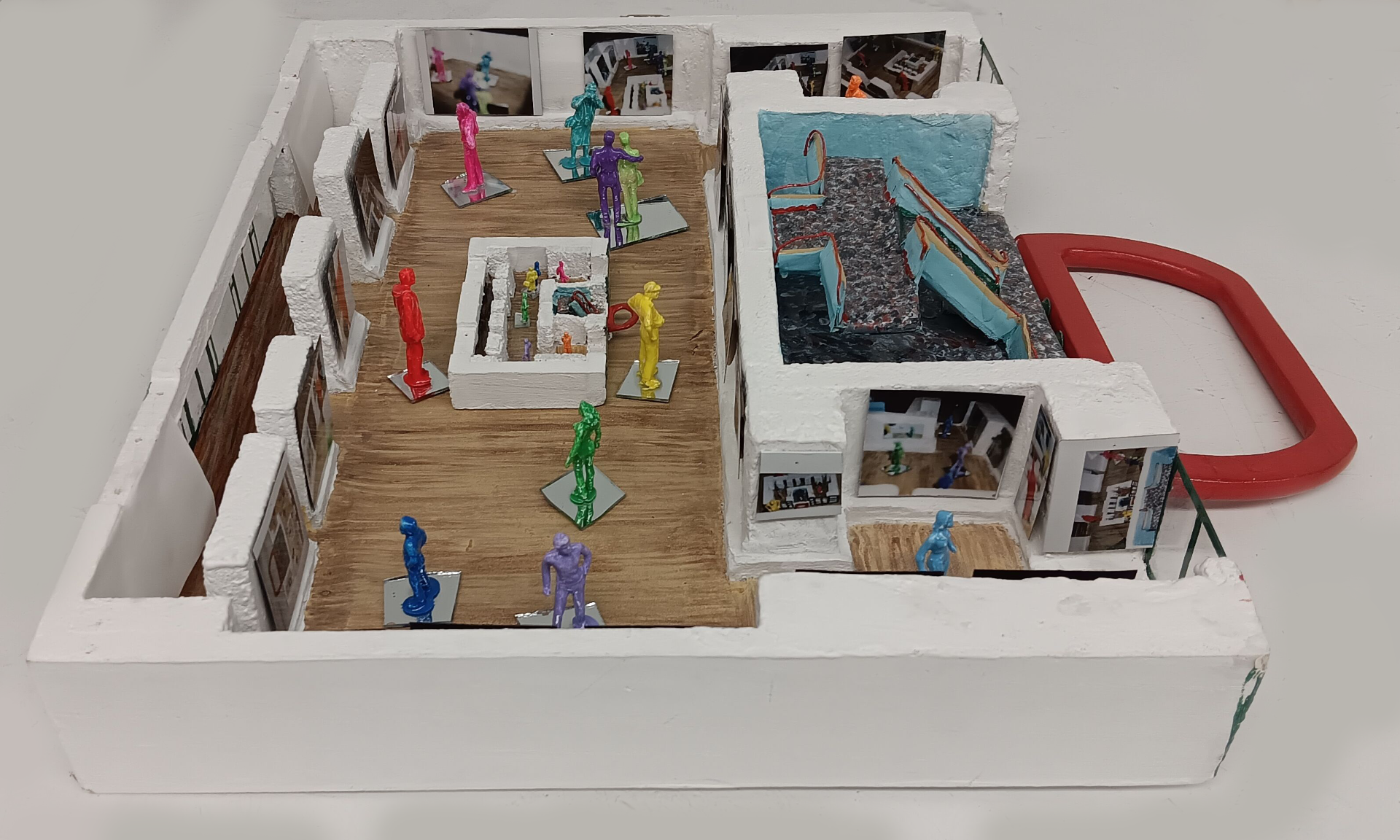
Untitled
Sculpture Installation
December 12, 2023 – February 2, 2024 CUNY Queens College Student Gallery, Klapper Hall, 4th Floor
Pine wood, recycled cardboard, plaster cloth, detachable leather handle, box latch clasp, hinges, screws, recycled acrylic sheets, toothpicks, magnets, contact paper, corkboard, miniature people figurines, acrylic paint, adhesives, mirrors, nail polish, Polaroid, epoxy resin, soda can tab, masking tape.
11.5" × 2" × 14"
A sculpture about the room it was installed in.
Drawing on Eleanor Filipovic's writings on the white cube, Untitled examines the gallery as an ideological space, one that does not neutrally display art but actively transforms it by isolating objects from their context and rendering them sacred. Created for Senior Projects I at CUNY Queens College, the work was exhibited in the student gallery it questions.
On display, the piece carried no title and no description. The detachable handle and reduced scale made it portable, removable, easily installed and uninstalled, a formal argument about how effortlessly galleries extract art from the world it came from.

Define Me in All Your Ways
Shadow Installation
May 13 – 17, 2024 CUNY Queens College Student Gallery
Acrylic hinges, acrylic screws, Plexiglass panels, flashlights, vinyl tablecloth.
12" × 12"
A series of negative relief sculptures rooted in André Breton's concept of the "Grand Transparents", forces that manifest not in themselves but through the sensations they produce: fear, chance, the feeling of being moved by something unseen (Prolegomena, 216).
Define Me in All Your Ways is a self-portrait built from that premise. It rejects conventional lighting as a means of encountering the human body, asking participants instead to look through the vessel works themselves to perceive what is depicted within them. Seeing requires an act.
That act is the argument. Our bodies are the primary vessels through which we are known by others, and yet some people are perpetually looked past, spoken at, and present without being received. To view this installation is to practice a different kind of attention: to look for a body rather than at one, and to feel, briefly, the effort that invisibility requires of those who bear it.

Technologies of Embodiment
Living Mask
2023
Adhesive, dinner plate, hot glue, make-up, sewing pin, silicone rubber, synthetic hair, resin.
7" × 6" × 3"
A study in museum practices of display, the exhibition of human specimen and portraiture as objects of scientific, aesthetic, and ethnographic inquiry.
The mask is already a face and its absence simultaneously. Here, silicone and synthetic hair meet the domestic and cosmetic, dinner plate, make-up, hot glue, collapsing the distance between clinical display and the everyday rituals through which bodies are made presentable. Both are technologies of the same kind: systems for rendering a body fit to be seen.
The work asks what we inherit when we look at a body put on display, and what we participate in by looking.

In the Mood for Love: Chinese Lantern Tree
Papier Mâché Sculptural Installation
2023
Adhesive, acrylic paint, alcohol marker, artificial leaves, cardboard, cellophane wrapping paper, clay pot, coffee, coin bank, dumbbell, plaster of Paris, egg carton, foam noodle, hanger, masking paper, masking tape, ready-made concrete, rice, reflective paper, rock, string lights, sawdust, tracing paper, trash bag, water-based oil paint, watercolor, wire.
7' 7" × 1' 4" × 4'
Three sources, held together: the Chinese Lantern plant (Physalis alkekengi), Wong Kar-wai's In the Mood for Love, and the history of Chinese Lantern Festivals, in which women were once permitted to move through public space after dark, gathered around light, outside the bounds of ordinary life.
What these share is an understanding that the most charged experiences, love, longing, freedom, and wonder, rarely announce themselves directly. They arrive obliquely, through color and obscurity, through the weight of ordinary things made strange.
Built from found objects and recycled materials, and using papier-mâché and paper-folding techniques, this sculpture reinterprets the cyclical life of the Chinese Lantern plant as a structure for gathering. Its artificiality is the point: nature observed, then imaginatively reassembled. A metaphor for ancestry, intimacy, and the things we build together from whatever we have.


The Simpsons' Car
Set Prop — Found Object Kinetic Sculpture
Mr. Burns: A Post-Electric Play April 20 – 30, 2023
Acrylic paint, bamboo pipes, bath towel, beer bottles, bicycle wheels, cardboard, caution sign, chicken wire, children's sports scooter, colander, dart board, flamingo décor, marker, nails, PVC pipes, radio, soup cans, staircase knobs, string, telephone, trash can lid, washing board, window pane, found wood.
4' × 4' × 6'
Anne Washburn's Mr. Burns: A Post-Electric Play imagines survivors of a collapsed electrical grid preserving culture by performing episodes of The Simpsons from memory, with whatever they have left.
This kinetic sculpture was built for the play's second act, in which a traveling theatrical troupe rehearses Cape Feare. The Simpson family car had to exist as they would build it: from scavenged materials, found objects, and the logic of a post-electric world. Nothing purpose-built. Everything repurposed.
Exhibits

Paradoxical
Self-portrait
2019
Water-based oil on canvas
11" x 14"
Heavily inspired by Caravaggio's tenebrism, this piece attempts to understand an unstable self-image. Capturing the duality and androgyny of its refracted reflection, the human persona emerges from an abyss of unknowingness.
Featured cover on the 2020 Annual Juried Student Exhibit for Queensborough Community College's Art & Design Department and Student Activities.

I Won't Complain
Screenshot rendition
2019
Charcoal on reeves paper
N/A
From Benjamin Clementine's beautifully bizarre music video and song I Won't Complain, this drawing suspends a glimpse into the unapologetically shy growth of a claustrophobic and vulnerable composition.
Showcased drawing in the 2020 Student Exhibit titled "Portrait Show" for Queensborough Community College's Art & Design Department and Student Activities titled

Which
Self-portrait
2019
Water based oil on canvas
24" x 36"
Being the prequel to Paradoxical, it is the beginning of "realistic surrealism". Influenced by Salvador Dali's Crucifixion and Francis Bacon's Three Studies for a Self-Portrait, the piece is a muted study of brush application, expression, and intrinsic oddities.
It is the pictorial monolith which propels and haunts, impersonating the ghastly struggles of the artistic spirit.
The first self-portrait completed in Queensborough Community College's advanced painting class, a looking glass observing naturally distorted elements of realism.

Passing Time
Abstract Drawing
2019
Graphite on Bristol paper
10" x 7"
After tracing lines from Le Corbusier's Still Life, adjacent shapes were shaded in opposing directions to create a metaphor for the passages of time. The hours dedicated to the drawing's cogwheels, ironically embodied its incremental and integral span. Unconsciously, the overwhelming design of disarray orders the fragility of its technical accomplishments.
Featured work in the 2020 Annual Juried Student Exhibit for Queensborough Community College's Art & Design Department and Student Activities.
Studies


The Performer & The Performer's Shadow
Painting and Drawing
2023
Acrylic and oil paint on canvas / Graphite and white conté on toned paper.
24" × 30" & 14" × 18"
A performer exists in two registers at once: the body that moves through space, and the trace that movement leaves behind. The shadow is not an absence. It is a record: proof that something stood in the light long enough to cast one. Together, the two works propose that the performer and the shadow are not opposed but interdependent.
Drawing & Painting Studies
January – May 2023
Ceramics Studies
January – May 2023
Digital Photography
YOU TREATED OUR LOVE LIKE IT WAS A PARTY YOU THREW JUST FOR US AND NOW THE PARTY'S OVER AND EVERYONE IS GONE
August – December 2022
Fundamentals
Fall 2021
Invisible Man
Relief Sculpture
2021
Clear clay on picture frame with spotlight.
18" × 22"
This piece was completed in order to be removed.
A portrait of an invisible man, clear clay stretched and arranged on glass, legible only when light passes through it from behind. Without the spotlight, there is nothing to see. With it, a silhouette emerges: present, but only just.
The sculpture no longer exists as an object. It lives now only in the memory of those who saw it, and in this photograph.
2015 - 2020
Samples of Auditioning Pieces for SUNY Purchase College
Spring 2021
Asthma
Mixed Media Drawing from Digitally Altered Photo Reference
2018
Pen, highlighters, watercolors, white acrylic paint, black marker, tape.
8" × 11"
This piece began with a photograph of myself, digitally manipulated, saturated, inverted, rearranged, then rendered by hand.
The work emerged from an Introduction to Art Therapy course at CUNY Queensborough Community College, in which a lesson explored the use of medical supplies as artistic mediums: an exercise in associating positive reinforcement with the materials of healing. The assignment asked us to reflect on that association. I reflected on the nebulizer mask.
I have had asthma my entire life. The mask is familiar in the way that only something uncomfortable and necessary can be, the artificial sensation of relief, the long stillness required while the medication vaporizes completely, the strange intimacy of depending on a device to breathe. A synthetic flower placed within the mask stands in for that artificial relief: something that resembles the natural, performing a function the body cannot manage on its own.
The layers of medium are not incidental. The uncomfortably vibrant colors were chosen to embody the strangely heightened sensations the medication produces, the feeling of being chemically corrected back into breath.
THINK WIDE OPEN (or, The Drawing Hand Draws Itself)
Gesture Drawing from Observation
2020
Pen on paper.
4½" × 8"
This drawing was made on a park bench, one of the few places visited during the pandemic to escape sibling abuse at home. Suffering from social anxiety, the act of drawing eased the panic of being present in a public space. The hand depicted is the hand that drew it: observed, traced, and actively engaged in the act of its own depiction as a way of managing overstimulation.
The drawing began at the tip of the pen, the point of origin, and worked outward. As each mark was made, more information became available: the relationship of the pen to the grip, the grip to the proportions of the hand. After each mark, the drawing hand returned to its initial pose to study itself more accurately. The result is a gesture drawing of a hand in the act of observing itself, creating itself.
To think wide open is to hold that act, the recursive loop of observation and creation, as a model for how we move through the world. It is a practice of persistent optimism against the pressure to conform: the willingness to pursue principled questions without the validation of others, while remaining honest about the uncertainty of whether any of it will matter. Our thoughts are glimpses into what remains closed to us. Our pilgrimage into the future builds and tears down the structures of the past so that others may one day consider their view with ours included.
If I Could Give You a Better Tomorrow
Performative Sculpture
2020
Watercolor on cotton inside a plastic snow globe filled with water, suspended on thread.
3" × 3" × 3"
This piece asks only one thing of the viewer: to look into the clouds for a moment.
A plastic snow globe filled with water. Inside, pulled pieces of cotton painted with watercolor, tied to thread and suspended, spun, the globe whirls, and the cotton moves the way clouds move through a lit sky. That is all it is, and that is the point.
The title names what the work cannot do. We cannot give each other better tomorrows. We can offer, at most, a moment of shared looking, a brief immersion in the hope of one. This sculpture was made for that moment, and for anyone who needs it. It is meant to be spun again and again, by anyone, indefinitely.
EIGHT
Typography
2020
Digital media.
6" × 6"
A palindrome, like a reflection, can be read in more than one direction.
This piece is built from four words, step, pets, time, emit, each a palindrome or reversal of another, arranged so that the design reads clockwise or counterclockwise, vertically or horizontally. The viewer is invited to rotate it. There is no single correct orientation.
The outer layer was constructed by rotating the surrounding letters 90 degrees from the starting points S and P. The inner layer was built through 180-degree rotations and reflections. Layered and overlapping, the texts create depth, refracting the digital painting beneath them the way a glitch refracts an image, breaking it into something that reveals its own structure. Primary colors move through the design's alternating transparencies, creating a cyclical narration with no fixed beginning or end.
Shadow Tracing
Acrylic Painting
2020
Acrylic paint on picture frame glass.
10" × 12"
Revisiting the park, one of the few places available during the pandemic for quiet and escape, a glass picture frame was placed on a dark, flat surface resting on the lap. Black acrylic paint was used to trace the contour of leaf reflections cast from the tree above: not the leaves themselves, but their shadows, their outlines, the version of them that light and glass made available.
The frame was then placed on a scanner with white paper beneath it and enhanced digitally to redefine contrast, the traced shadow becoming a print, the print becoming the final object.
The process draws inspiration from Islamic art and its tradition of abstaining from direct depictions of human or animal form, a constraint that redirects attention toward pattern, geometry, and the natural world as a surface for contemplation rather than representation. Shadow tracing was also, more immediately, a way of managing social anxiety: a quiet, absorbing act that made the presence of a public space bearable.
The painting does not attempt to perfectly render nature. It celebrates the impossibility of doing so, and the beauty that remains in the attempt.
TEN
Surreal Figurative Painting
2020
Digitally saturated alcohol markers and pen over watercolor and acrylic paint on paper.
6" × 8"
This piece began with a face painted onto a face.
A Francis Bacon self-portrait was applied directly onto the skin, then photographed in front of a colorful, collared shirt and a mirror. The photograph was digitally manipulated to saturate the colors, then hand-rendered in layers, paint, marker, pen on paper, before being scanned and manipulated again, each pass deepening the image's emotional register. Finally, the painting was repeated in layers and tilted, collapsing into an abstracted landscape of faces.
The process mirrors what it depicts. Each layer of translation, skin to photograph, photograph to painting, painting to scan, scan to composition, introduces a new degree of distance from the original image, the way dissociation introduces distance from the original self. The hazy, saturated colors of the surreal figurations embody the melancholic euphoria of drifting into an imagined reality: the strange comfort and disorientation of cognitive dissonance, the feeling of watching yourself from somewhere slightly outside your own body.
Bacon painted figures as though they were caught mid-dissolution. This painting continues that impulse, and turns it inward.
Land of
Drawing from Imagination
2015
Pen on colored paper.
8" × 11"
Every face in this landscape was drawn without drafting, beginning at the bottom of the page and working toward the horizon. The drawing was completed in pieces: classrooms, train rides, buses. Transitory locations for a transitory period.
The work was made during an unstable point in life. The monstrous landscape, is a macro view of a nightmarish scene, each face individually rendered and accumulating into something larger and more unsettling than any one of them alone. It is a drawing about fearing unknown strangers, made in the middle of them, one face at a time.
Anywhere but Here
Drawing from Observation
2020
Pen on cut paper and magazine collage.
4½" × 8"
Drawn from observation in my love's car, a vehicle that served, during the pandemic, as a kind of safe haven: a contained space for inspiration, creativity, and the feeling of being somewhere other than where life had become.
The drawing depicts the claustrophobic interior of that space honestly, then intervenes. The windows, mirrors, and glass panels were cut out and replaced with tranquil sceneries and floral vegetation, liberation imposed onto confinement, the view outside made into something the view outside never actually was. The paraphernalia scattered throughout the piece documents the personal items and materials of daily life during that period: small evidence of who was there and what they carried.
In the passenger seat, the artist is depicted depicting the depiction.
Anywhere but here is a destination, a direction, and a love letter to the feeling of almost being free.
My Heart Is an Inoperable Fidget Spinner
Origami Sculpture
2020
Newspaper with blue and red thread.
4" × 5"
This piece is folded from a single copy of the New York Post, its cover story, Nailbiter, a right-leaning newspaper chosen deliberately. Blue and red thread stitch opposite sides of the heart-shaped form, each color pulling against the other. The spinner cannot spin. Its size and weight make it inoperable by design.
The fidget spinner was a cultural object of 2017, a toy marketed as a tool for managing anxiety, a way of channeling nervous energy into idle, repetitive motion. Here it becomes a heart: the organ most associated with feeling, rendered as a mechanism for coping with feeling, made from the media that helped produce the anxiety in the first place. The New York Post cover captures the uncertainty of election night. President Biden's victory is present in the blue thread stitched over that image of nail-biting, not a resolution so much as a new kind of uncertainty, announced in the color of one party over the image of another.
The piece cannot do what it promises. It is too heavy, too large, too contradictory to function. A disheveled object built from disheveled times, a heart that cannot settle, stitched together from things that do not agree.
wasitacatisaw
Self-Portrait
2020
Dry erase markers on picture frame glass.
10" × 12"
A self-portrait drawn on glass, the frame placed on a dark, flat surface resting on the lap, one eye closed, layers of blue and brown dry erase marker tracing the outline of a face that kept shifting as the hand moved across it. The tracing was scanned with white paper beneath it, then digitally altered to enhance saturation and contrast.
The title is a palindrome. Read left to right or right to left, it asks the same unanswerable question, the irony of any reflection, which shows you yourself only in reverse, only at a distance, only as others do not see you. A self-portrait is always an approximation. The glass made that literal: a surface that reflects before it records, that gives back an image before it accepts a mark.
What the photograph cannot capture is documented in the supplemental video: the difficulty and ambiguity of the process itself, the gap between looking and seeing, between the face and its representation. What remains is the trace. What it means is left to whoever is looking.